Build
The Hidden Ingredient in Your Home’s Ceramic Tiles

Ceramic tiles offer more than surface beauty. A tile’s durability, moisture resistance, and lifespan depend largely on the raw clay beneath the glaze. As a refined mineral stabilizer, kaolin gives tile bodies essential structural strength and thermal stability.
Understanding its role helps homeowners and builders look past the finish to choose materials engineered for long-term residential performance.
Understanding Ceramic Tile Composition
Ceramic tile composition relies on a carefully balanced combination of raw materials. Manufacturers commonly use a triaxial formulation.
Traditionally, three primary components make up ceramic tiles:
- Clay minerals: Kaolin and other clays contribute to the ceramic body’s structure, shaping characteristics, and strength before firing. Kaolin offers unique properties such as increased strength and water resistance.
- Feldspar: This mineral acts as a flux, promoting the formation of a glassy phase that helps densify the tile during firing.
- Silica: Quartz provides dimensional stability and helps regulate shrinkage and thermal expansion.
Proportions vary by application and firing temperature. Kaolin contains alumina and silica, which stabilize the clay body. At high temperatures, this combination forms crystalline phases that enhance the finished tile’s strength.
How Kaolin Powers Ceramic Tile Durability and Performance
Kaolin’s value extends far beyond basic raw clay. Its microscopic structure, thermal resilience, and mineral purity directly dictate how tiles behave in the kiln and perform on the jobsite.
Microscopic Structure and Material Consistency
Kaolin is composed of tiny, hexagonal crystals measuring around 0.1 to 10 micrometers wide. These microscopic platelets naturally arrange into stacked layers, allowing raw clay particles to pack together tightly during hydraulic pressing. This tight packing eliminates micro-voids, increases green-body density, and ensures the tile dries evenly without cracking.
In a word, kaolin becomes the backbone. It holds the tile components together, increasing strength and resilience.
Thermal Stability and Mullite Reinforcement
Kaolin, which becomes mullite when it contains other minerals, has a high melting point, helping tile bodies fuse at kiln temperatures without losing stability. As firing progresses, kaolin contributes to the formation of mullite, a crystalline structure that strengthens the tile from within.
The reinforcement helps improve breaking strength, impact resistance, and thermal shock stability, making the finished tile less likely to crack under everyday stress, temperature changes, or long-term residential use. That property is essential in today’s climate-change conditions that affect residential and commercial properties.
Vitrification and Low Porosity
During clay firing, flux minerals melt into a glassy phase that helps close small pores within the tile body. This process lowers water absorption, which is especially important for tiles used in showers, bathrooms, patios, and other moisture-prone areas.
Porcelain tile is defined by the Tile Council of North America as having a water absorption rate of 0.5% or less, making it highly resistant to moisture penetration, subsurface mold and freeze-thaw cracking in wet or outdoor spaces.
Dimensional Stability and Clean Installations
Because high-grade kaolin shrinks predictably in the kiln, large tiles fire flat with virtually no cupping, bowing or warpage. For vertical wall installations, that flat profile is critical.
A warped tile leaves voids where thin-set cannot bond, creating weak spots that allow heavy tiles to slip out of position, pop loose or crack.
Dimensionally true tiles ensure full, even mortar contact from edge to edge, locking large panels securely to the wall while keeping grout joints tight and minimizing lippage.
Mineral Purity and True Color
High-purity kaolin contains minimal iron impurities, allowing the bisque to fire to a clean, pale off-white rather than dark terracotta red. This neutral foundation provides the ideal canvas for high-definition digital inkjet glazes, ensuring surface colors, intricate patterns and faux-stone veining remain vibrant and true without clay bleed-through.
Where Ceramic Tile Performance Matters Most
Different residential environments place distinct demands on ceramic surfaces. Understanding these conditions helps homeowners and builders select materials with suitable performance characteristics.
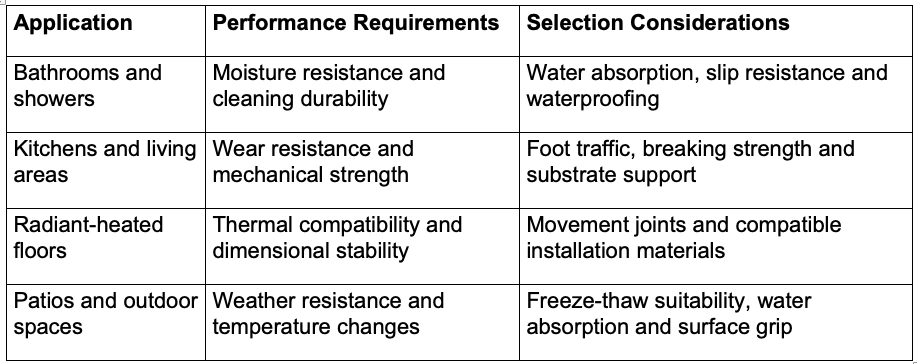
For example, a homeowner renovating a bathroom might choose low-absorption porcelain for the shower floor and glazed ceramic tiles for the walls. Both materials can perform effectively when their specifications match the installation requirements.
Case in Point: Why the Sydney Opera House Roof Has Lasted Over 50 Years
The Sydney Opera House roof offers a useful case study in ceramic tile durability. Located on Sydney Harbour, the building’s roof tiles are exposed to regular sun, rain, salt air and changing temperatures.
To meet those conditions, architect Jørn Utzon spent three years working with Swedish tile maker Höganäs to develop a custom ceramic tile. In total, around 1.4 million roof tiles were produced to cover the shell-shaped domes.
The tiles were made with kaolin-enriched clay and a small percentage of crushed stone, creating a durable surface suited to the building’s exposed marine setting.
The example shows why the composition of ceramic tile matters. A dense, well-fired tile body can limit moisture movement, reduce surface deterioration and support long-term performance in demanding environments. While a landmark roof operates on a different scale than a home remodel, the same principle applies to residential projects.
The minerals and manufacturing process used to make a tile help determine how well it performs over time.
How to Evaluate Ceramic Tile Quality
Appearance provides only part of the information needed to assess ceramic tile longevity. Homeowners and builders should also consider measurable performance characteristics before making a selection:
- Water absorption: Verify the manufacturer’s absorption rating, particularly for wet areas and exterior installations.
- Manufacturing standards: Look for compliance with relevant standards and review the manufacturer’s technical specifications.
- Dimensional accuracy: Assess thickness, flatness, and rectified edges when planning installations with narrow grout joints.
- Application suitability: Consider traffic, moisture exposure, slip resistance, and maintenance requirements.
Material quality must also align with installation conditions. Even high-performance tiles can crack or fail when installed over unsuitable substrates or without adequate movement accommodation.
Why Ceramic Composition Matters for Long-Term Performance
The minerals beneath a tile’s decorative surface play a substantial role in its strength, stability, and resistance to environmental conditions. Kaolin contributes valuable characteristics to ceramic formulations, supporting controlled manufacturing and the development of durable finished materials.
Understanding ceramic tile composition allows homeowners and builders to look beyond surface finishes and assess the qualities that influence performance. Combined with appropriate specifications and installation practices, well-manufactured ceramic tiles can provide reliable, long-lasting surfaces throughout the home.