
Buy
How Trees and Mature Landscaping Can Affect Edmonton Property Values
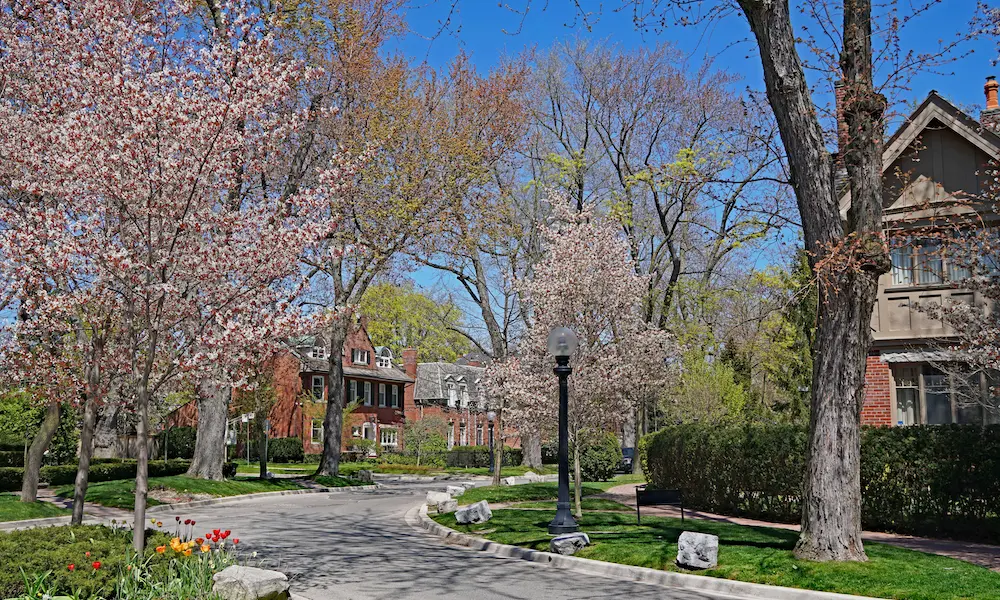
Tree canopy covers about 13% of Edmonton, and the city looks after more than 419,888 boulevard and open space trees to keep that figure where it is. Those trees are distributed unevenly.
A buyer touring Glenora or Highlands in July walks under a closed canopy of 70-year-old elms, and a buyer touring a 2016 subdivision in the southeast walks past saplings staked against the wind. The gap between those two streets shows up in appraisals, in summer utility bills, and in the repair budget a new owner inherits.
Canopy Cover and Tree Ownership
About 90,000 of the city’s inventory are American elms, and they account for more than 22% of Edmonton’s canopy. The concentration of mature American elm here is the largest anywhere, because the prairie climate kept the disease that flattened elm populations elsewhere out of the province until 2024.
The city wants canopy cover at 20% by 2071 and has committed to planting 2 million trees to get there, with a volunteer program adding a target of 45,000 a year.
A buyer today is looking at a canopy roughly two-thirds of the way to that goal, unevenly spread, and a new subdivision will not catch up inside one ownership cycle.
A boulevard tree in front of a house is city property. The homeowner who mows around it has no say in when it gets pruned and no free hand to build near it during a renovation.
Placement and Distance to the House
Distance from the building changes the effect. A large tree at a sensible distance from the building shades the roof in August and gives the street the look buyers pay for.
The same species planted two meters off a foundation puts roots into clay soil that swells and shrinks with moisture, drops limbs on the roofline, and blocks the light from south-facing rooms.
Published estimates put the gain on houses near street trees between 3% and 15%, with mature specimens at the upper end of that range. Listings of homes for sale in Edmonton on treed streets in the older core typically show higher prices than those in newer subdivisions, with the canopy often being an unspoken factor. The June listing photos show the difference most plainly.
The Public Tree Bylaw
Edmonton council passed a bylaw protecting trees on public property in August 2021. Any work within five meters of a boulevard or open space tree, or within 10 meters of a natural stand, needs a permit or an approved preservation plan first, and the fine for skipping that step is $1,000.
The rule matters most during renovations. A garage pad, a new driveway approach, a service trench or an infill build on a lot with a large boulevard tree out front now involves an application that did not exist a decade ago.
Private trees are a separate matter, since no bylaw currently requires a permit to remove a tree on private land, and a proposed one would not take effect until later in 2026.
The Elm Inheritance
Dutch elm disease was confirmed in Edmonton in August 2024, and the city has identified fewer than 20 infected trees since. The management plan is aggressive because the alternative is worse.
Elm pruning is banned from April 1 to September 30, when the beetles that spread the fungus are active and drawn to fresh cuts, and the city may remove a healthy elm within 20 meters of an infected one because the root systems connect underground.
Tree advocates have argued the city should widen the spacing between elms, plant a wider mix of species, and stop planting elm entirely in new developments. Their argument about the urban forest warns about concentration risk, and it applies to a single property as much as to a whole city.
A yard where all four large trees are elm is one detection away from a very different yard.
Maintenance Costs for the New Owner
A 60-year-old tree needs periodic work from someone qualified to do it at height. Removal of a large specimen in a tight backyard, with no alley access and power lines overhead, is a four-figure job before stump grinding.
Roots find sewer laterals in older neighborhoods, and the first sign is usually a backed-up floor drain in the basement of a house bought three months earlier.
A mature tree is still the better inheritance. A study of Chicago neighborhoods reported by Live Science found that keeping old trees standing did more for residents’ health than planting replacements, because a sapling delivers almost nothing for 20 years.
A buyer inheriting a healthy 60-year-old spruce is inheriting an asset with a maintenance schedule attached, and the schedule belongs in the offer calculation.
Grading, Drainage and the Soil Underneath
In Edmonton, landscaping is regulated as a drainage question before it is an aesthetic one. Drainage Bylaw 18093 governs lot grading, and the goal is to move stormwater away from the foundation and toward the street or a designated swale.
Final grading has to be finished within 12 months of rough grade approval, and a residential property is expected to be fully landscaped within 18 months of occupancy.
The soil is heavy clay, which is why the rules are specific. A finished lot needs roughly a 2% slope away from the foundation walls under 4 to 6 inches of screened topsoil, and decorative rock or wood chip cannot be used to make up a grade deficiency, since surface water runs straight through both and pools against the wall.
An investor buying a newer build with unfinished landscaping is buying an outstanding obligation with a deadline.
An investor buying a 1970s property with mature beds and a settled grade is buying the opposite problem: 50 years of accumulated drainage decisions made by previous owners.
Summer Heat and Utility Costs
Edmonton summers are shorter than most of the country’s, and the urban heat pattern still applies to its asphalt and rooftops.
Cities run 1 to 7 degrees Fahrenheit warmer than the land around them, and vegetation combined with lighter surfaces pulls peak daytime temperatures down by several degrees.
For a landlord, that gap is an operating number. A west-facing rental with no shade on the wall runs its air conditioning harder through July and August, and tenants in a suited house on a treed lot complain less about the upstairs bedrooms in a heat wave.
Tree Valuation by Position
Researchers in Sydney matched more than 1,500 house sales against nearly 50,000 public trees and found that one street tree added roughly $30,000 to a sale price, and the same tree planted too close to the building subtracted $70,000.
The market and species differ in Edmonton, but the relationship between position and price is the same.
A tree is worth what its position makes it worth, and on a lot in Bonnie Doon or Ritchie, somebody else decided that position in 1965.
